Xi'an's Muslim Quarter is one of the great street food corridors in Asia — lamb skewers, roujiamo, persimmon cake, and pomegranate juice. Here is how to eat your way through it without the tourist traps.
I'm Baker Gu, and the Muslim Quarter in Xi'an is one of the three or four food experiences I always tell New Zealand clients to clear an afternoon for. Not a lunch stop. An afternoon.
Xi'an was the eastern terminus of the Silk Road, and for over a millennium it was one of the most cosmopolitan cities on earth. Arab and Persian merchants who travelled the Silk Road settled here, intermarried with the local population, and established a community — the Hui people — whose culinary traditions are now 1,300 years deep. The Muslim Quarter (Huimin Jie) is the living result.
What You're Walking Into
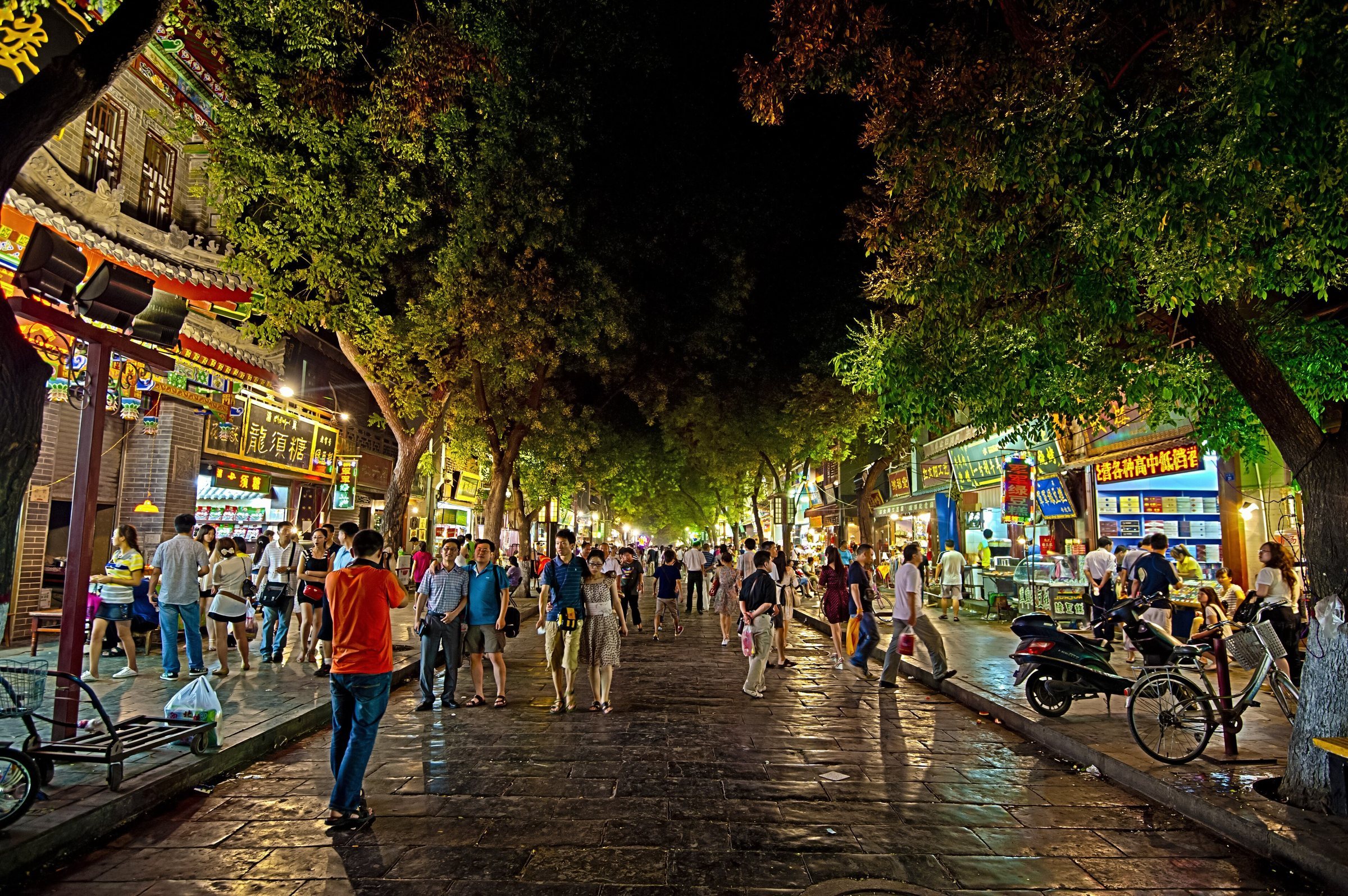
The Muslim Quarter is a working neighbourhood, not a reconstruction. The Great Mosque of Xi'an — one of China's largest and oldest Islamic sites, founded in 742 AD — sits at its centre. The streets leading to it are narrow, loud, fragrant, and densely packed with food stalls, restaurants, and vendors selling everything from lamb bones to persimmon vinegar.
The main artery is Beiyuanmen Street, about 500 metres long, but the real eating is in the side alleys where the vendors who've been doing this for generations have their permanent stalls.
What to Eat
Roujiamo is the Xi'an dish I recommend starting with. It is sometimes described as the world's oldest hamburger: slow-braised pork (or lamb in halal versions) chopped and stuffed into a round, slightly crispy flatbread baked in a clay oven. The bread is baked fresh and the filling is warm. CNY 8–15 depending on size and filling.
Lamb skewers (羊肉串, yángròuchuàn) are everywhere, but the quality varies. Look for the stalls with charcoal grills and visible smoke — these are the ones where the lamb has been marinated properly and is cooked to order. Cumin, chilli, and salt are the seasonings. Two or three skewers per person before anything else.
Yangrou paomo is Xi'an's signature dish and the one that requires the most commitment. A bowl of rich, slow-cooked lamb broth arrives at your table with two large rounds of unleavened flatbread. You break the bread into pieces — the smaller the better, traditionally thumbnail-sized — and drop them into the broth, which is then returned to the kitchen and cooked briefly until the bread has absorbed the liquid and become tender. This takes preparation. Most restaurants hand you the bread and wait for you to break it before the bowl goes to the kitchen. It is excellent, deeply warming, and not appropriate if you are in a hurry.
Persimmon cake (柿子饼, shìzi bǐng) is a sweet Xi'an speciality: dried persimmon paste mixed with walnuts and other fillings, pressed flat and pan-fried. The stalls near the mosque entrance make them fresh. CNY 5 each.
Fresh pomegranate juice is pressed to order at stalls throughout the Quarter. Xi'an pomegranates are genuinely excellent in season (August to November). If you are visiting at other times, the juice is still good.
Biangbiang noodles are Xi'an's most famous noodle: hand-pulled, belt-wide, served with chilli oil, black vinegar, and toppings that vary by stall. The character for "biang" is famously complex — 58 strokes, not included in any standard font, usually hand-written on the restaurant signs. The noodles are excellent and substantial.
Navigating Without Tourist Traps
The front-facing stalls on Beiyuanmen are often less authentic and more expensive than what you find 50 metres into the side alleys. A useful rule: if the sign is in English with photos of every dish, look for the next option. The stalls with handwritten signs in Chinese and a queue of local students are the ones worth finding.
We deliberately do not rush the Muslim Quarter on our Xi'an days. It is structured as a self-guided afternoon with a local-recommended starting point, then time to wander without a schedule.
The Great Mosque
Before or after eating, take 30 minutes to walk through the Great Mosque. It is not a tourist attraction primarily — active prayers happen five times daily — but the grounds are open to non-Muslim visitors outside prayer times, and the architecture is extraordinary: a mosque built in Chinese architectural style, with pagoda-like minarets and tiled roofs that look distinctly Chinese until you notice the Arabic calligraphy and the qibla orientation.
Entry is CNY 25. Dress modestly. Women are asked to cover their hair at the entrance (scarves are provided).
Practical Details
- Location: Beiyuanmen Street, inside the ancient city walls, about 10 minutes by taxi from the city centre
- Best time: Late afternoon (4–7pm) when the stalls are busiest and the food is freshest
- Budget: CNY 80–150 per person covers a thorough eating session
- Language: Most food stalls operate by pointing — the food is visible, prices are posted
See Xi'an on our Beijing and Xi'an tour or as part of our Signature journey.