The Jiangnan water towns — canal cities, classical gardens, silk culture, and West Lake — are a different China from Beijing and Xi'an. Here's what makes them special and how to experience them from New Zealand.
Most travellers planning a first China trip think of Beijing and the Great Wall. The Jiangnan region — the watery lowlands south of the Yangtze, centred on Suzhou, Hangzhou, Wuxi and Shanghai — is a completely different China: canals instead of avenues, gardens instead of palaces, tea hills instead of steppe. For many of our NZ clients it ends up the most lasting memory of the whole trip. Here is what makes it special and how to do it well.
What Does Jiangnan Mean?
Jiangnan literally means south of the river — the Yangtze. Since the Song Dynasty (960 AD) this delta has been the richest region in China, and the culture that grew here is distinct: refined, literary, and aesthetically precise. The classical garden tradition, Suzhou silk and embroidery, Kunqu opera (older than Beijing opera), Hangzhou's tea culture, and the canal network that once linked every town — all of it belongs specifically to Jiangnan.
The practical consequence for travellers: the region rewards slowness. The distances are short, the trains fast, and the best moments — morning mist on a canal, an empty garden courtyard — come to people who are not rushing.
Which Water Town Should I Choose?
The canal towns are the region's signature, and they are not interchangeable:
- Zhujiajiao — under an hour from Shanghai, built around the great arc of Fangsheng Bridge. The easiest half-day water-town trip in China. Our Zhujiajiao guide covers it in detail.
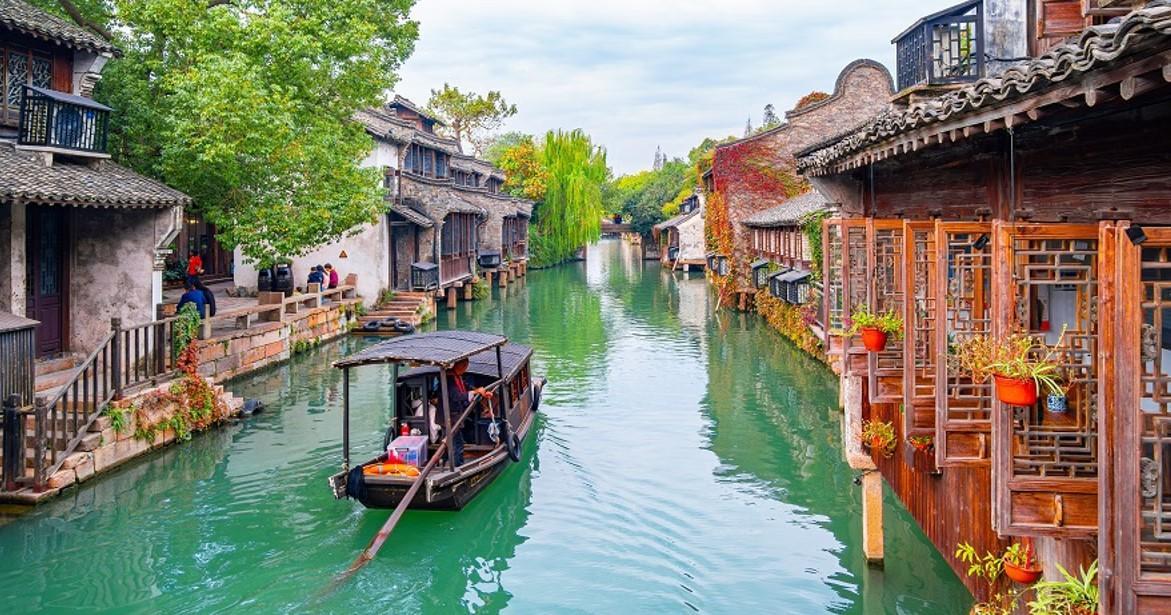
- Wuzhen — the most carefully restored, split into two scenic zones; the western zone at dusk, after the day-trippers leave, is the single best water-town experience in the region. Worth an overnight stay.
- Xitang — famous for its kilometre of covered waterside walkways and lantern-lit evenings; livelier and more commercial.
- Tongli and Luzhi — smaller towns near Suzhou where daily life continues between the visitors; the quiet choices.
If you only have one slot, take Zhujiajiao as a Shanghai day trip or give Wuzhen a night. If water towns become your favourite thing — it happens — two or three fit easily into a ten-day loop.
Why Do People Rave About Suzhou?
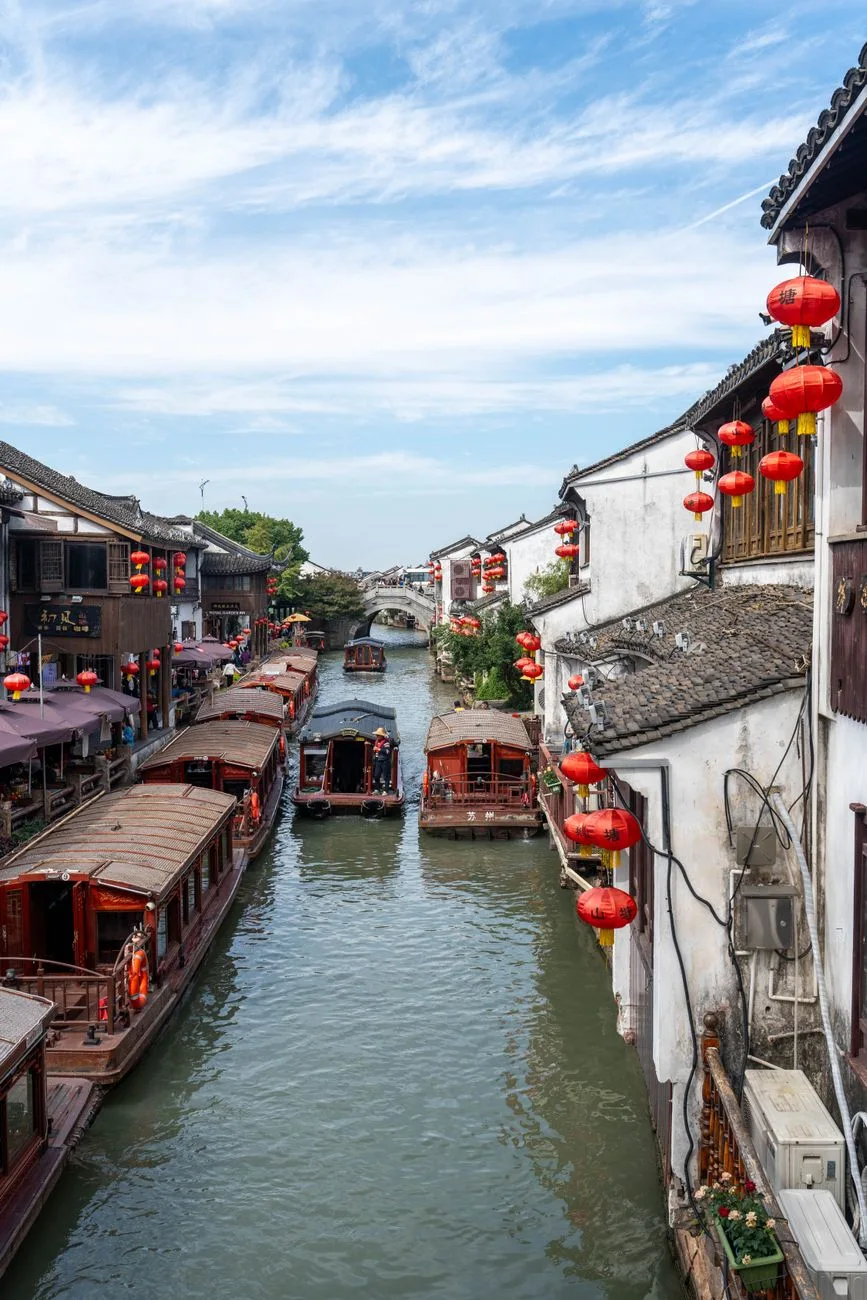
Suzhou has run on water for 2,500 years, and the old quarter around Pingjiang Road still works the way the Song-dynasty maps drew it: whitewashed houses, stone bridges, boats sliding along narrow canals. Walk it before 9am and you will have it almost to yourself.
The city's nine UNESCO-listed classical gardens are the concentrated expression of Jiangnan culture — compressed landscapes where rocks stand for mountains and ponds for lakes. See the Humble Administrator's Garden for scale, the Master of the Nets Garden for perfect proportion, and the Lingering Garden for its extraordinary rockery. Our Suzhou gardens guide explains how to visit them well; the short version is: two gardens properly beat five gardens quickly.
What About Hangzhou and West Lake?
Hangzhou's West Lake is the most celebrated landscape in Chinese art — a thousand years of poets and painters have fixed its causeways, pagodas and misty islands in the national imagination. Walk or cycle the Su Causeway early, take the boat to the island of Three Pools Mirroring the Moon, and give the lakeshore an unhurried evening. Our full West Lake travel guide has the details.
In the hills directly behind the lake grow the tea bushes of Longjing (Dragon Well) — China's most prized green tea. A half-day in the tea villages, watching the leaves hand-fired in hot woks and tasting the grades in sequence, connects you to a tradition running back to the Tang Dynasty. The spring harvest in late March and April is the most atmospheric time.
How Do the Logistics Work?
This is the easiest region in China to travel independently or in a small group: Shanghai, Suzhou and Hangzhou form a triangle 30 to 90 minutes apart by high-speed rail, with trains every few minutes. A comfortable shape for the region is 7 to 10 days — three nights Shanghai (with a water-town day), two Suzhou, two or three Hangzhou. Our 10-day Shanghai and Jiangnan itinerary lays out the full route day by day.
When to go: late March to May, or September to early November. Avoid the first week of October, when National Day holidays fill the entire region. And remember NZ passport holders currently enter China visa-free for up to 30 days, so the trip books with nothing more than passport and flights.
Experiencing Jiangnan With CTS
Our Shanghai and Surroundings Discovery tour covers this exact region — Shanghai, Suzhou, Hangzhou and a water town in one comfortable loop. From NZD 2,699 per person twin share including airfares from Auckland.
View the full tour →, or browse Shanghai, Suzhou and Hangzhou tours.