Sichuan hot pot is China's most social meal — a bubbling communal broth with a ritual that takes all evening. Here's the full guide: history, broth types, what to order, and how to eat without embarrassing yourself.
Hot pot is not a dish. It is an event. A Sichuan hot pot dinner in Chengdu or Chongqing typically occupies two to three hours, involves more food than you planned to eat, produces a quantity of soup-stained clothing, and ends with everyone at the table considerably happier than when they sat down.
A Brief History of the Bubbling Pot
The practice of communal cooking in a central vessel of broth is documented in China from the Zhou Dynasty (1046–256 BC), making it one of the oldest surviving Chinese culinary traditions. The Sichuan hot pot as we know it today — with its characteristic mala broth of dried chillies, Sichuan peppercorns, and fermented broad bean paste — developed in Chongqing along the docks of the Yangtze River in the late Qing Dynasty.
Dock workers on the Chongqing waterfront cooked offal and cheap cuts of meat in a communal pot of spiced broth to make otherwise undesirable ingredients edible and warming through long river nights. The dish moved up the social scale through the Republican period, acquired more refined ingredients, and became the centrepiece of Sichuan dining culture. Today it is one of the most consumed dishes in China.
The Broth: Where Everything Starts
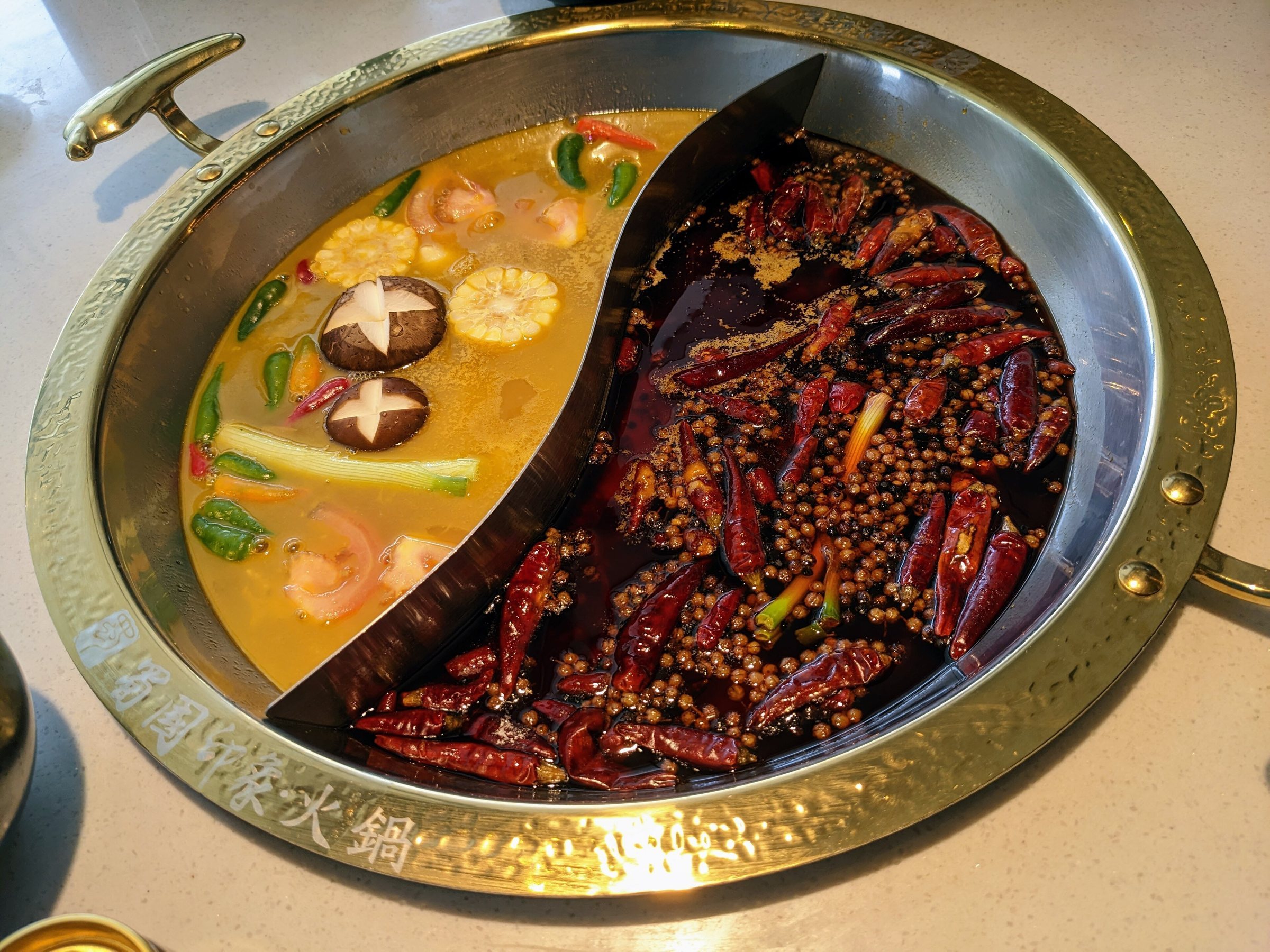
Sichuan hot pot broth is either red (红汤, hóng tāng) or white/clear (清汤, qīng tāng), or divided in the famous "yin-yang" pot (鸛鸯锅) that provides both in separate halves.
Red broth is the authentic Sichuan version: a base of beef tallow (牛油, niúyóu) into which dried chillies, Sichuan peppercorns, doubanjiang (fermented broad bean paste), ginger, garlic, and various spices are fried and then simmered. The resulting broth is deep red, intensely fragrant, and aggressively spiced. This is what Chengdu and Chongqing restaurants have been serving for a century.
Clear broth is usually a light chicken or mushroom stock. Less dramatically flavoured, but allows the ingredients' natural tastes to come through. Recommended if you are sensitive to heat, or want to taste delicate items like fresh tofu and vegetables without the chilli masking them.
The yin-yang pot is the practical compromise for groups with mixed heat tolerances.
What to Order
The raw ingredients are ordered from a menu and brought raw to the table, to be cooked at your personal pace in the communal broth. Ordering strategy:
Meat: Thinly sliced beef and lamb are the standards — they cook in 10–15 seconds and are best eaten immediately. Pork belly, duck intestine, and beef tripe are more adventurous but excellent with proper preparation. The intestine in particular is a Chongqing speciality: cleaned, scored, and blanched before service, it cooks to a satisfying crunch in the broth.
Seafood: Prawns (shell on, head on), fish balls (whether hand-made or extruded — the hand-made versions are noticeably better), and shellfish where available.
Vegetables: Lotus root is the classic hot pot vegetable — it absorbs the broth while retaining its crunch. Potato slices, winter melon, and leafy greens (spinach, chrysanthemum leaves) all work well. Mushrooms — oyster, enoki, king oyster — are the most flavoursome.
Tofu and noodles: Silken tofu comes apart in the broth and becomes infused with the mala flavour. Order it last, when the broth has concentrated. Hand-pulled noodles are added near the end of the meal to soak up the remaining broth.
The dipping sauce: This is where Sichuan hot pot diverges from Mongolian hot pot tradition. In Sichuan, each diner constructs their own dipping sauce at a condiment station: sesame paste is the base, then dried chilli flakes, garlic, spring onion, coriander, fermented tofu, oyster sauce, and sesame oil in proportions of your choosing. The sauce moderates the broth's heat and adds its own flavour layer.
The Ritual of Eating
Cooking times matter. Sliced meat: 10–20 seconds. Intestine: 30 seconds. Lotus root: 1–2 minutes. Dense vegetables: 3–4 minutes. Tofu: 3 minutes. If you overcook the sliced meat, it becomes tough.
The correct sequence at a Sichuan hot pot: vegetables and tofu into the broth first (they can survive overcooking better), then meat, then seafood, then repeat as desired. The noodles come last when you are full but the broth is too good to waste.
Do not add cold water to the pot. This happens. It ruins the broth temperature and disrupts the cooking. If the broth reduces, ask for more stock (the restaurant will provide it free).
Where to Eat It
In Chengdu: Haidilao (海底捞) is the internationally known chain — impeccable service, consistent quality, and the spectacle of noodle-pulling performance tableside. Worth experiencing once. For more local character, the independent hot pot restaurants in the Yulin district or around Tongzilin are where Chengdu residents actually eat.
In Chongqing: Liu Yishou (刘一手) is the most recognised local chain; independent restaurants along the riverside near Nanbin Road are more atmospheric.
Budget CNY 100–200 per person (NZD 23–47) for a thorough hot pot session including drinks.
Hot pot is on the final evening agenda of all our Chengdu and Chongqing tours. Browse our Chengdu tours or contact us to build a Sichuan food itinerary.