Discovered in 1974 by farmers digging a well, the Terracotta Warriors are still being excavated today. Here is the full story of China's most astonishing archaeological site, and how to visit it properly.
In March 1974, a group of farmers digging a well near Xi'an, Shaanxi Province, struck something unexpected at 1.5 metres depth: terracotta fragments, and then a bronze arrowhead, and then — as they dug wider — the upper torso of a life-size clay figure. They had accidentally broken into the largest archaeological discovery of the 20th century.
The Mausoleum of Qin Shi Huang and its surrounding burial complex have been under formal excavation since 1976. The dig is ongoing today.
Who Was Qin Shi Huang?
Qin Shi Huang (259–210 BC) was the first person to unify what we now call China. Before him, the territory was divided into seven competing kingdoms in a period of constant warfare. After a military campaign that took 17 years, Qin conquered all of them by 221 BC, declared himself the first emperor, standardised writing, currency, and measurements across the empire, and then immediately began preparing for his death.
Construction of his tomb started when he was 13 years old — the year he became king of the state of Qin. By the time he died at 49, an estimated 700,000 workers had spent decades building the complex. The underground palace at the centre has never been opened.
The terracotta army was not discovered by archaeologists first. It was known, in fragmentary form, to local farmers for generations — pieces of clay figures would surface during ploughing. The systematic excavation only began after the 1974 discovery.
The Three Pits
Three pit halls are open to visitors. A fourth pit was found empty, interpreted as a construction project interrupted by the emperor's death and the rebellion that followed.
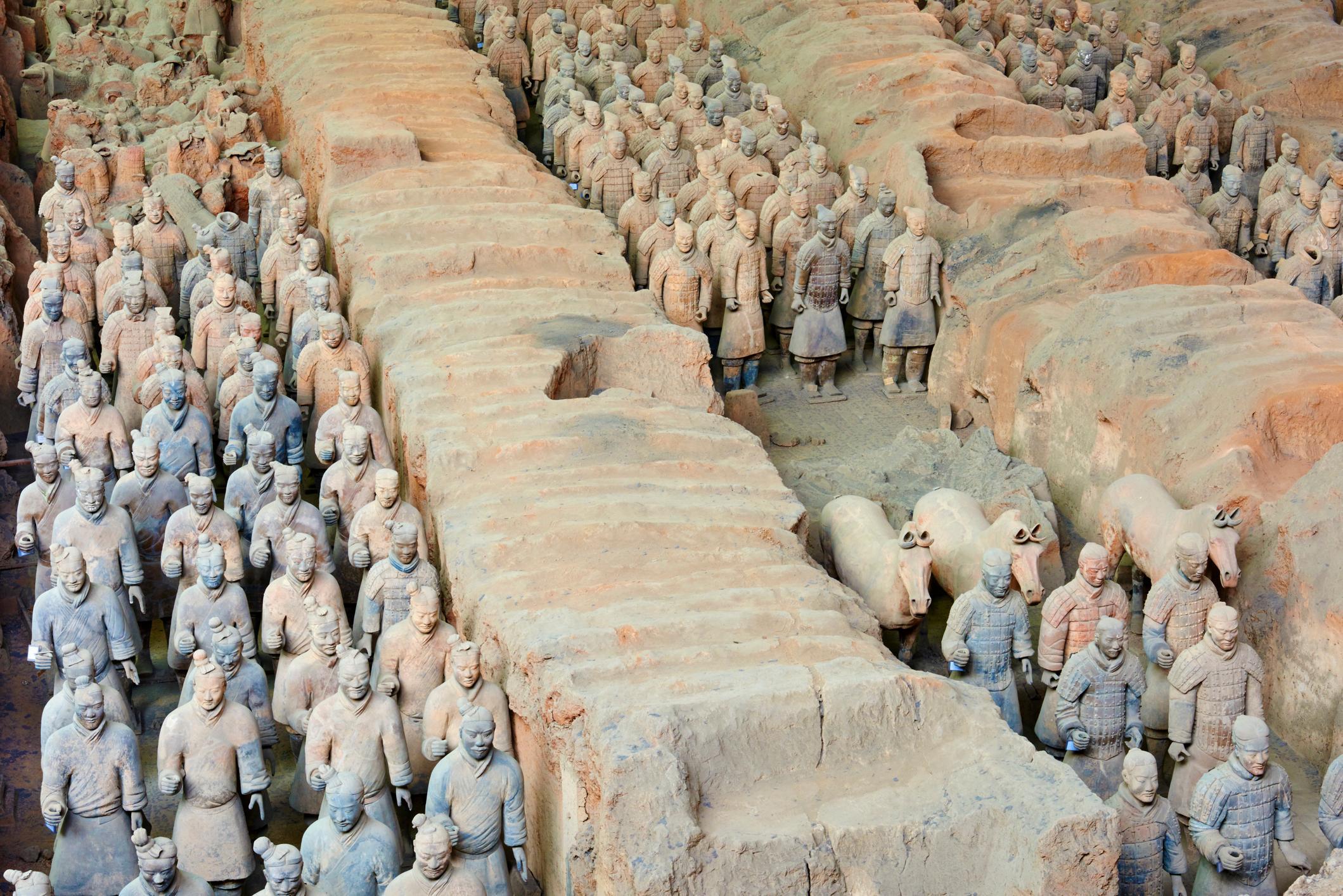
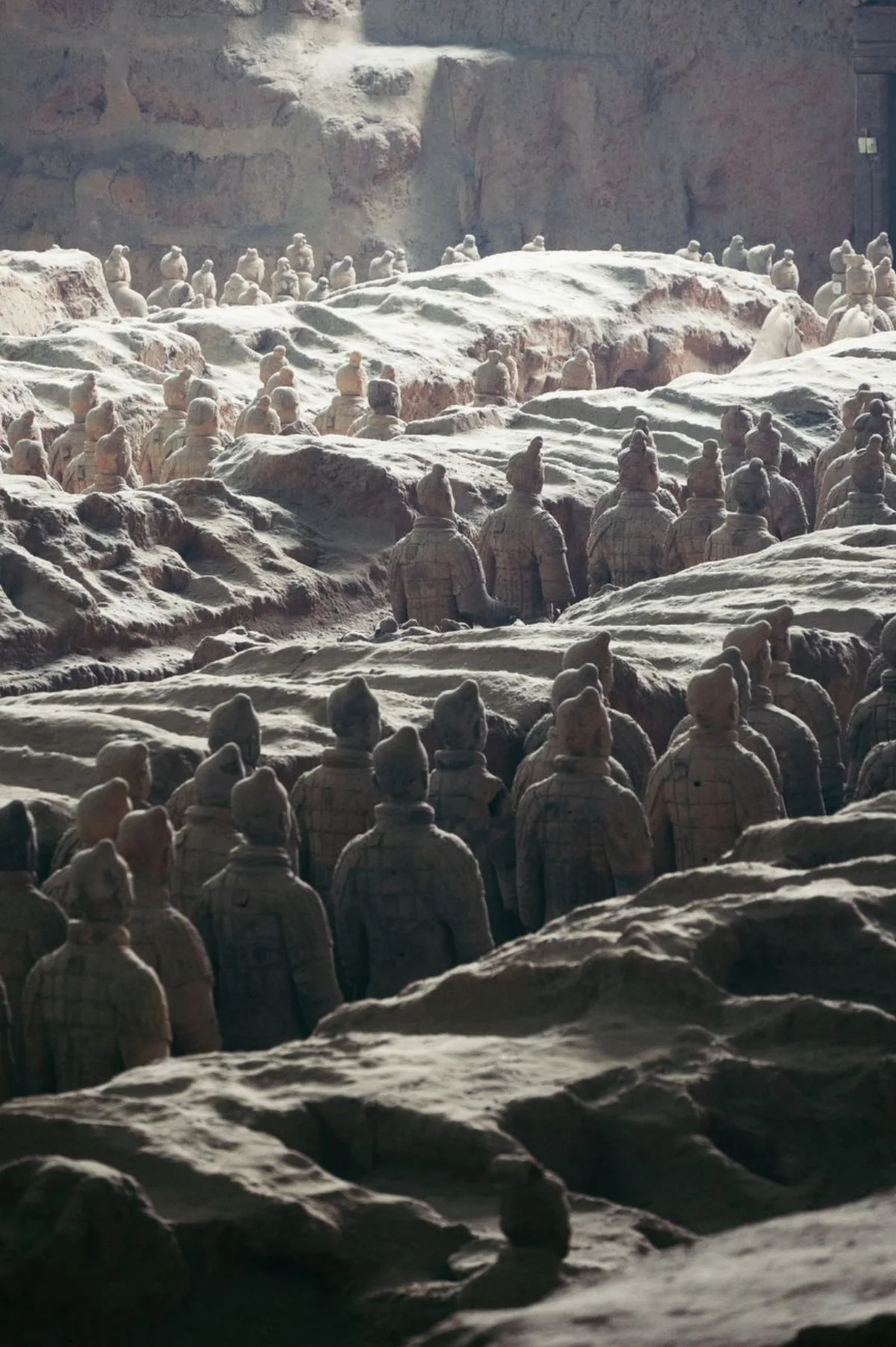
Pit 1 is the famous one: a cavernous hangar 230 metres long and 60 metres wide, containing approximately 6,000 infantry figures in 11 parallel corridors. From the observation platforms along the sides, the scale is difficult to process. The figures are life-size (average height 1.8 metres) and stand in formation, many still in the original positions they were placed in over 2,200 years ago.
Pit 2 contains cavalry, chariots, and archers in kneeling position. This is where most of the restored individual figures are displayed at close range — you can study the facial expressions, the distinctive hairstyles, the detailed armour construction up close in a way that Pit 1's scale does not allow.
Pit 3 is the smallest and is interpreted as the command structure — the high-ranking officers and command chariot that would have directed the military formation in the afterlife. Only 68 figures were found here.
No Two Faces Are Alike
This is the detail that stays with visitors longest. Each of the estimated 8,000 terracotta figures has a distinct face. They were not mass-produced from moulds — the bodies were, for efficiency, but each head was individually sculpted and attached. Historians believe they may represent actual people: soldiers, officers, or individuals known to the craftsmen who made them.
What Has Not Been Excavated
The central tomb mound — the large earthen hill visible from the car park — has not been opened. Ancient records describe rivers of mercury inside, representing the rivers of China, with a ceiling map of the heavens. Modern soil surveys have detected significantly elevated mercury levels around the mound, consistent with these descriptions. The Chinese government has made the decision not to excavate until preservation technology has advanced enough to protect what will be found.
Visiting Practically
The site is 35km east of Xi'an city and takes about 45 minutes by road. Most tours include a stop at the nearby Huaqing Hot Springs (where the Tang Dynasty emperors brought their favoured consorts) on the same day.
Allow a minimum of two hours at the pits themselves; three is better. The complex is large, the indoor temperature in summer is high, and the Museum of Qin Shihuang Terracotta Warriors and Horses adjacent to the pit halls is worth 45 minutes of your time.
- Opening hours: 8:30am–5:30pm (summer); 8:30am–5pm (winter)
- Ticket price: CNY 120 (NZD 28) including all three pits and the museum
- Photography: Permitted in all pit halls; tripods are not allowed
- Audio guide: Essential — the context makes the experience
See this extraordinary site on our Xi'an tours or as part of our Beijing and Xi'an Discovery tour.